Posts

Showing posts with the label analysis

Note on Translation and Meaning

Image
Introduction I (Richard) enjoy comparing translations of texts. For example, last year I published Comparing Translations of Itosu’s Ten Precepts of Karate  and Did Miyamoto Musashi Say Something Like "There is nothing outside of yourself..."?  Translation is key to this post as well. Douglas Wile Today I started reading T'ai Chi's Ancestors: The Making of an Internal Martial Art by Douglas Wile, 1999. I had just taken a look at his 1996 book  Lost T'ai-chi Classics from the Late Ch'ing Dynasty . In the 1999 book he includes the following story on pages 3 and 4: "Allusions to soft-style martial arts theory go back to the classical period. Chinese history and literature record two interesting encounters between martial artists and monarchs. The Wu-Yueh ch'un-ch’iu , Annals of the states of Wu and Yueh ) compiled during the Han (206 BCE - 221 CE) relates a dialogue between the King of Yueh and a woman warrior named Yueh Nu. In response to the King’s pl...
Beware Your Sources: A Brief Look at Kano Jigoro's Paper on Jiujutsu and Jiudo-Judo

Image
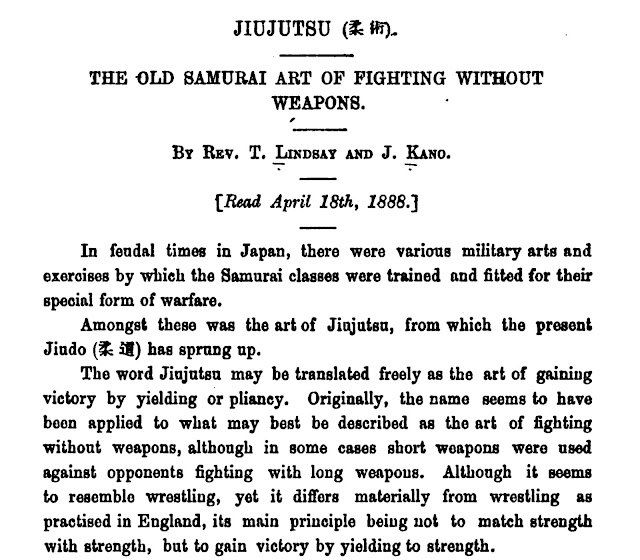
  Introduction While working on the monthly Martial History Team book survey, I needed to research the famous late 19th century paper on "jiujutsu" by professor Kano Jigoro and the Reverend Thomas Lindsay. A quick Google search yielded the version hosted by Judoinfo titled "Jujutsu and the origins of Judo, by Jigoro Kano and T. Lindsay, 1887, (Transactions of the Asiatic Society of Japan, Volume 15)." In addition to seeing the word "judo" in the title, I saw it throughout the online text, e.g., "Amongst these was the art of jujutsu, from which the present judo has sprung up." This did not seem right to me, so I investigated further. Going to the Source Thanks to the wonderful Internet Archive , I was able to find a copy of the original article in its original form. It appeared in Volume XVI (16), not volume "15", of the Transactions of the Asiatic Society of Japan, published in 1889, not 1887. The paper notes that the authors read it t...

Does the Budōshoshinshu Use the Term Jūdō?

Image
Does the Budōshoshinshu use the term jūdō? Martial History Team member Matthew Krueger investigates. Introduction Richard Bejtlich recently posted a survey of samurai philosophy texts .    In it he quoted from a section of the Budōshoshinshu  as follows:    “Beyond these, there are the many arts of archery, iaido [drawing the sword and cutting in one movement] and judo; and it is important that young warriors exert themselves day and night to learn these arts well."   He then asked the question:    “Note that I am not convinced the original text uses the term jūdō. It would be worth revisiting the original text to see the Japanese.”   This is an important observation. I also highly doubt it.  The Modern Japanese This is one of the few texts I do not have in the original archaic Japanese, but I do have a modern Japanese translation.    A modern Japanese rendition of that sentence is as follows:   其の他、弓、鉄砲、居合、柔等という萬の武藝と共に、若い...

Investigating a Suspicious Book Cover

Image
  Just who are these gentlemen? Introduction This post documents my investigation of the men in the photo above. It is a version of the cover of a 2020 book by Marc Lawrence titled  The Scientific Study of the Shanghai Municipal Police Methods Manual . The cover presumes to show two famous proponents of combatives, namely Captains Fairbairn and Sykes, plus two men who were their instructors -- professors Okada and Tsai. The former specialed in jujutsu and the latter in Chinese boxing. This article offers a few details. The cover as shown at Amazon appears below. The Scientific Study of the Shanghai Municipal Police Methods Manual , Marc Lawrence, 2020 The problem with this photo is that half of the labels are demonstrably false . Fairbairn? First, the gentleman labelled William E. Fairbairn is actually Harold Peck.  The original photo can be found in the Historical Photographs of China collection as "Harold Peck with three men."  We can identify the man as Harold P...

Dr Paul Bowman on Making Martial Arts History Matter (2016)

Image
A few months ago I (Richard) wrote a post titled Why Should Practitioners Care About Martial Arts History?   I spoke about this on Whistlekick Live in December 2020 , thanks to host Jeremy Lesniak.  (Note the Pedro Sauer gi over my work shirt.) Whistlekick Live, 2 December 2020 Thanks to a post in a private Facebook group, I came across a quote from a 2016 article by Dr Paul Bomwan titled  Making Martial Arts History Matter . As I read the entire paper, I realized I had encountered some or all of the material before -- probably in one of Dr Bowman's excellent books. I decided to highlight a few passages here, as they speak to the relevance of martial arts history. I thought Dr Bowman's article was well-cited and made several compelling points. I have added all of the emphasis in bold to Dr Bowman's original material. "Unsurprisingly, in much scholarship on Asian martial arts, the matter of history remains freighted and weighted down by the same popular myths; so much ...

Why Should Practitioners Care About Martial Arts History?

Image
 Why should practitioners care about martial arts history?  Introduction To answer this question, I'd like to divide martial arts practitioners into two approximate, somewhat stereotypical, camps. Division should not be the goal of the martial arts community. However, it is difficult to analyze as broad a group as "all martial artists." My hope is that these terms will facilitate the identification of common characteristics and the formulation of reasonable conclusions. The first group consists of people who seek excellence by replicating or emulating the original teachings of their art. I call these practitioners emulators . The second group includes people who seek excellence by testing their art against other practitioners. I call them contestants . There is overlap among the groups, but this differentiation provides a rough starting point for the discussion. I seek no value judgement concerning either group and I have personally trained in both modes. Emulators Within...

"The Complete Kano Jiu-Jitsu" Is Not Judo

Image
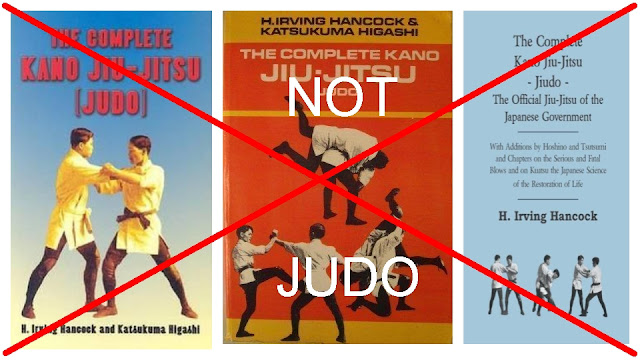
  Introduction  Once in a while I will encounter a reader who has fallen for a 115-year-old scam perpetrated by martial arts authors trying to capitalize on the name of judo founder professor Jigoro Kano. In today's post, I'd like to take a look at this scam, and make it easier for others to know what they are reading. It doesn't mean readers should avoid the book. I'm more interested in "truth in advertising." The (so-called) Complete Kano Jiu-Jitsu (Judo) That scam is the 1905 book  The Complete Kano Jiu-Jitsu (Judo) by H. Irving Hancock and Katsukuma Higashi, published by G. P. Putnam's Sons. Interior of The Complete Kano Jiu-Jitsu (Judo) by H. Irving Hancock and Katsukuma Higashi, G. P. Putnam's Sons, 1905. The foreword to the book says the following: The Complete Kano Jiu-Jitsu (Judo) by H. Irving Hancock and Katsukuma Higashi, G. P. Putnam's Sons, 1905. It reads in part "This volume, therefore, presents, in its entirety, the Kano system...