Posts

Showing posts with the label china

Note on Translation and Meaning

Image
Introduction I (Richard) enjoy comparing translations of texts. For example, last year I published Comparing Translations of Itosu’s Ten Precepts of Karate  and Did Miyamoto Musashi Say Something Like "There is nothing outside of yourself..."?  Translation is key to this post as well. Douglas Wile Today I started reading T'ai Chi's Ancestors: The Making of an Internal Martial Art by Douglas Wile, 1999. I had just taken a look at his 1996 book  Lost T'ai-chi Classics from the Late Ch'ing Dynasty . In the 1999 book he includes the following story on pages 3 and 4: "Allusions to soft-style martial arts theory go back to the classical period. Chinese history and literature record two interesting encounters between martial artists and monarchs. The Wu-Yueh ch'un-ch’iu , Annals of the states of Wu and Yueh ) compiled during the Han (206 BCE - 221 CE) relates a dialogue between the King of Yueh and a woman warrior named Yueh Nu. In response to the King’s pl...
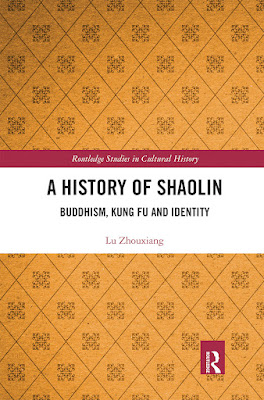
Book Review: A History of Shaolin: Buddhism, Kung Fu and Identity by Lu Zhouxiang

Image
Introduction Martial History Team member Dr. Jonathan Clements is the author of today's book review. For more posts featuring Dr. Clements' work, please see this label . The Abrupt Appearance of Martial Arts True to the historical record, Lu Zhouxiang’s A History of Shaolin: Buddhism, Kung Fu and Identity (Routledge, 2019) has relatively little to say about the Shaolin monastery’s connection to the martial arts before the 16th century. His early chapters are thick with detail on the various ebbs and flows of Buddhist traditions at the temples, and come with meticulous genealogies of the various leading monks. Shaolin, after all, is a prime site in the history of Chan (i.e. Zen) Buddhism, but Lu points out that it was also an important and respected institution in several other sects, which co-existed peacefully with the one that made it famous. Then, suddenly, we see the temple’s public image radically transform. Lu quotes Cheng Shao, who wrote in 1620: “ Taking a rest at Sha...

Notes on Dr Lorge Interview

Image
  Dr Paul Bowman interviewed Dr Peter Lorge again on his excellent series on martial arts studies. I took the following notes and decided to publish them, in case anyone also finds them interesting. Not everything in China is at least 2000 (or 5000 years old).  China is not "unchanging and forever." Not everything good about Japan, Korea, or Vietnam came from China. French wine in a foreign country doesn't become domesticated, but physical practice does. "Confucianism" was an attempt by European scholars and missionaries to create a secular intellectual tradition in opposition to Taoism and Buddhism. They viewed what they called "Confucianism" as being like Christianity, except without Jesus, and it became their means to try to convert Chinese people to Christianity. Buddhism entered China around the first century CE. Dr Lorge prefers the term " Ruist " to "Confucian." "Confucianism" has changed over time based on who ass...

Perusing Old Martial Arts Manuals

Image
A Facebook post prompted me to take a look at a few old martial arts manuals today.  Introduction  This post mentioned that a book published in the 18th century in Japan, titled Morokoshi Kinmō Zui, or Illustrated Encyclopedia of China, contained copies of Chinese texts, specifically texts from Chinese generals Qi Jiguang and Yu Da You. I had mentioned them before in the post Mail Call: Sword Treatise . I decided to track down the aforementioned encyclopedia and see what it looked like. I preface this post by saying I am not a Japanese or Chinese language or history expert. I was simply interested in finding the original texts I read about on Facebook. Here I am documenting what I am learning. Before getting to the documents, I want to say a few words about the two main characters mentioned earlier.  General Yu Da You and the Sword Treatise Sword Treatise, Jack Chen Edition The first is General Yu Da You 俞大猷, who lived 1503-1579. For the purposes of this post, we ar...

Hand-to-Hand Combat at the Top of the World

Image
India and China have been engaged in a border dispute in the Ladakh region of Indian-administered Kashmir for several decades. This map from the BBC shows the location of the latest flare-up , at the Galwan Lake. Galwan Lake Clash, BBC https://www.bbc.com/news/world-asia-india-53089037 Troops along the border have fought before, but this time soldiers, possibly on both sides, have died.  What is unusual about this engagement is that apparently the combat was all hand-to-hand. The BBC reported the following: "The image that emerged on Thursday showed crude weapons that appeared to be made from iron rods studded with nails. It was passed to the BBC by a senior Indian military official on the India-China border, who said the weapons had been used by the Chinese. Defence analyst Ajai Shukla, who first tweeted the image, described the use of such weapons as 'barbarism.' The absence of firearms in the clash dates back to a 1996 agreement between the two sides that guns and expl...

Annotating Wayne Muromoto's "The Legacy of Chin Gempin"

Image
Muromachi Period Samurai, 1538, Wikipedia Commons,  https://en.wikipedia.org/wiki/Muromachi_period#/media/File:MuromachiSamurai1538.jpg Introduction Quite often we in the martial arts hear the idea that the Japanese learned martial arts from the Chinese. The next step in that conversation is the mention of the Chinese scholar Chin Gempin (1587-1674), aka Chen Gemin / Chen Yuan-pin / Ch'en Yuan-pin / Chen Yuan-Ping / Chen Tsu U / Gin Chin Pin. He's sometimes cited as being responsible for the creation of grappling arts in Japan. In this post, I'd like to set up some context, and then provide an annotated version of a classic article that casts Chin Gempin's true role in Japanese arts, with a focus on grappling. Mentions of Chinese Origins for Japanese Grappling Arts Fundamentals of Shuai Chiao (Jiao) by Dr Daniel Weng, 1984 In Dr Daniel Weng's 1984 book Fundamentals of Shuai Chiao , we find claims like the following: "It has been proven that ...