Posts

Annotating Wayne Muromoto's "The Legacy of Chin Gempin"

Image
Muromachi Period Samurai, 1538, Wikipedia Commons,  https://en.wikipedia.org/wiki/Muromachi_period#/media/File:MuromachiSamurai1538.jpg Introduction Quite often we in the martial arts hear the idea that the Japanese learned martial arts from the Chinese. The next step in that conversation is the mention of the Chinese scholar Chin Gempin (1587-1674), aka Chen Gemin / Chen Yuan-pin / Ch'en Yuan-pin / Chen Yuan-Ping / Chen Tsu U / Gin Chin Pin. He's sometimes cited as being responsible for the creation of grappling arts in Japan. In this post, I'd like to set up some context, and then provide an annotated version of a classic article that casts Chin Gempin's true role in Japanese arts, with a focus on grappling. Mentions of Chinese Origins for Japanese Grappling Arts Fundamentals of Shuai Chiao (Jiao) by Dr Daniel Weng, 1984 In Dr Daniel Weng's 1984 book Fundamentals of Shuai Chiao , we find claims like the following: "It has been proven that ...

Martial Arts Ranks: Clarifying Origins, Colors, and the Father of Japanese Swimming

Image
The Legacy of Kano Jigoro: Judo and Education, by The Committee for the Commemoration of the 150th Anniversary of the Birth of Jigoro Kano, translated by Tom Kain, 2020 Introduction Martial History Team strives to promote martial arts history based on sound evidence and sourced research. Sometimes we don't find what we're looking for, so we write our own research, based on the best available sources, usually in the English language (unfortunately). This is the case with the origin of martial arts rank. The history of rank is almost as hot a topic as the debate about the value of rank itself! Hopefully this article will shed some light on a topic that often reproduces unsourced or poorly sourced claims. This article will support the following assertions: 1. Prof Mikinosuke Kawaishi did not invent colored judo belts; he only brought the idea with him to France in 1935.  2. Prof Jigoro Kano was not inspired by "swimming ribbons" or "swimming grades...

Rest in Peace, Professor Kano

Image
Prof Jigoro Kano, from Kano Sensei 嘉納先生伝 by Hengshan Jiantang 横山健堂 著, 1941 On this day in 1938, returning via Canada on the ship Hikawa Maru from a meeting in Cairo of the International Olympic Committee, Professor Jigoro Kano died, at the age of 77. Let us remember him fondly on this day. The photograph of him doing calligraphy is taken from this book: Kano Sensei 嘉納先生伝 by Hengshan Jiantang 横山健堂 著, 1941 It was thoughtfully provided online by Japan's National Diet Library Digital Collections . If anyone could translate it, I would appreciate it! If you like this article, check out our  Facebook page ,  Instagram  account, and  Twitter  feed. Be devoted!

Ulysses Grant vs Bullies

Image
Ulysses S. Grant, 1865, Ohio History Collection, https://www.ohiomemory.org/digital/collection/p267401coll32/id/11433  Introduction In my post Ulysses S. Grant, the Patient Fighter , I dispelled the myth that Grant was a wrestler. I started reading Ron Chernow's biography Grant with the goal of finishing it before the History Channel mini-series starts on May 25. In this brief post I'd like to share two stories I've encountered that demonstrate Grant stood up to bullies, either against himself or others. Both are from Chernow's book . As a Boy "Such a tame boy inevitably became the butt of mockery, and Grant grew sensitive to public humiliation. Never one to initiate a fight, he refused to back down when bullied. He was roused to fury if sadistic boys tormented an innocent child or a defenseless horse, and smaller boys embraced him as their steadfast protector. On one occasion, Grant saw a big, oafish boy named Slifer picking on a much smaller boy....

Mail Call: The Sword Treatise

Image
The Sword Treatise, Jack Chen, 2016 Introduction Mail call! Usually I post these as quick notes on the Martial History Team Facebook site . However, I wanted to share a little more detail on this book, although not a full review. I waited a while for this one. It took six weeks to arrive from Singapore, but I'm pleased to finally have a copy of Jack Chen's book 劍經 (Jian Jing), " Sword Treatise ." It is one section of the book 正氣堂集 (Zheng Qi Tang Ji), "Compilation of Vital Energy". The author is 俞大猷 (Yu Da-You), who lived 1503–1579 and was a Ming dynasty Chinese general. As you can see, this book is printed in the traditional Chinese stitch-binding method, which made it a must-have. I love specialty books like this. It's similar to my judogi-material-enclosed copy of the first edition of Kyuzo Mifune's Canon of Judo. About the Author After a quick search, the best reference I found about the author, General Yu Da-You, appears to be M...

Ulysses S. Grant, The Patient Fighter

Image
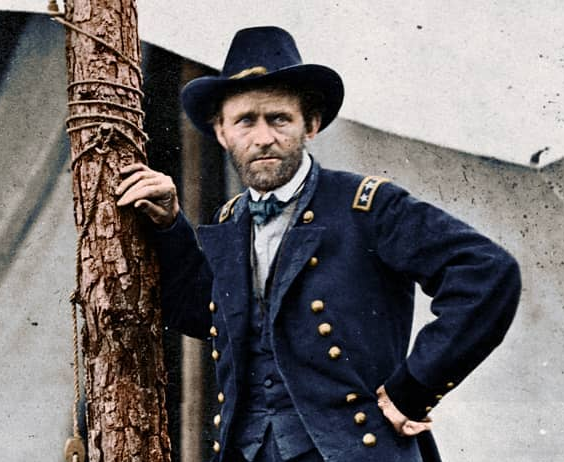
US Grant at Cold Harbor, May 1864; Photo by Mathew Brady, colorized by @madsmadsen.ch from Battlefield Trust collection,  https://www.instagram.com/p/BymcJKIBYvn/ Introduction Today, 27 April 2020, is the 198th birthday of Ulysses S. Grant, born Hiram Ulysses Grant, 18th president of the United States and commanding general of Union forces in the US Civil War. To celebrate his birthday, I will take a look at one of the myths surrounding Grant, his so-called "wrestling career." Grant is sometimes listed as one of the "Presidential wrestlers," alongside Abraham Lincoln, George Washington, and others. As we will see in this post, Grant there is no evidence that Grant was a wrestler, at least against other men, but there is evidence he was a family man and a patient fighter. Grant as Wrestler, Online If one visits the National Wrestling Hall of Fame web site , one finds the following: "Lincoln certainly did not achieve any national fame as a wrestl...

Answering the Top Five Questions on Theodore Roosevelt's Judo

Image
Richmond-Times Dispatch, 14 Nov 1917 Introduction One of the most popular set of myths found in a variety of media involves the association of President Theodore Roosevelt Jr. (1858-1919, 26th US president) with martial arts, especially judo or jiu-jitsu.  According to the Theodore Roosevelt Center : "Teedie [Theodore Jr.'s childhood nickname] battled frequent asthma attacks . In time, Theodore Sr. challenged his namesake 'to make his body' and overcome his infirmities. Eager to please the father he adored, Teedie committed himself to a regimen of vigorous physical activity , a routine that remained with him well into adulthood. After a confrontation with bullies who pummeled Teedie , Thee [Theodore Sr.] encouraged his son to take up boxing." That sounds a bit like other martial arts practitioners and founders profiled earlier on this blog ! So what are the myths and what are the facts? In the following, TR is an abbreviation referring to T...