Posts

Showing posts with the label books

Special Book Report: Who Wrote the Tao?
Image
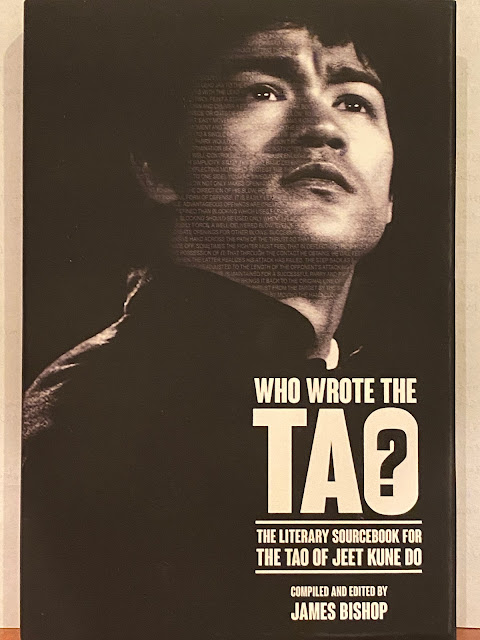
   This book should change how everyone thinks of Bruce Lee. Introduction Last month I learned of a new book titled Who Wrote the Tao? The Literary Sourcebook for The Tao of Jeet Kune Do , by James Bishop. I also watched a few  YouTube videos featuring the author. I quickly ordered a copy direct from the author and read the book. In brief, it's shocking. At least 85%, and probably more, of "Bruce Lee's" Tao of Jeet Kune Do is derived, and in many places directly copied or traced (in the case of "Bruce Lee's" drawings) from other authors. The Bruce Lee Library To arrive at this conclusion, Dr. Bishop hunted down the hundreds of books in Bruce Lee's library, digitized them, and then began searching them for phrases found in Tao . One of his sources was the many pictures of Bruce Lee in front of his book shelves, as shown in this Art of Manliness article : Dr. Bishop first pioneered this hunt for the titles in the library in his 2004 book Bruce Lee: D...
Book Review: A History of Shaolin: Buddhism, Kung Fu and Identity by Lu Zhouxiang

Image
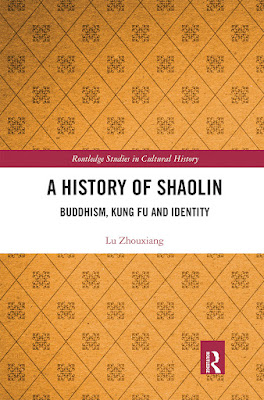
Introduction Martial History Team member Dr. Jonathan Clements is the author of today's book review. For more posts featuring Dr. Clements' work, please see this label . The Abrupt Appearance of Martial Arts True to the historical record, Lu Zhouxiang’s A History of Shaolin: Buddhism, Kung Fu and Identity (Routledge, 2019) has relatively little to say about the Shaolin monastery’s connection to the martial arts before the 16th century. His early chapters are thick with detail on the various ebbs and flows of Buddhist traditions at the temples, and come with meticulous genealogies of the various leading monks. Shaolin, after all, is a prime site in the history of Chan (i.e. Zen) Buddhism, but Lu points out that it was also an important and respected institution in several other sects, which co-existed peacefully with the one that made it famous. Then, suddenly, we see the temple’s public image radically transform. Lu quotes Cheng Shao, who wrote in 1620: “ Taking a rest at Sha...

Does the Budōshoshinshu Use the Term Jūdō?

Image
Does the Budōshoshinshu use the term jūdō? Martial History Team member Matthew Krueger investigates. Introduction Richard Bejtlich recently posted a survey of samurai philosophy texts .    In it he quoted from a section of the Budōshoshinshu  as follows:    “Beyond these, there are the many arts of archery, iaido [drawing the sword and cutting in one movement] and judo; and it is important that young warriors exert themselves day and night to learn these arts well."   He then asked the question:    “Note that I am not convinced the original text uses the term jūdō. It would be worth revisiting the original text to see the Japanese.”   This is an important observation. I also highly doubt it.  The Modern Japanese This is one of the few texts I do not have in the original archaic Japanese, but I do have a modern Japanese translation.    A modern Japanese rendition of that sentence is as follows:   其の他、弓、鉄砲、居合、柔等という萬の武藝と共に、若い...

Investigating a Suspicious Book Cover

Image
  Just who are these gentlemen? Introduction This post documents my investigation of the men in the photo above. It is a version of the cover of a 2020 book by Marc Lawrence titled  The Scientific Study of the Shanghai Municipal Police Methods Manual . The cover presumes to show two famous proponents of combatives, namely Captains Fairbairn and Sykes, plus two men who were their instructors -- professors Okada and Tsai. The former specialed in jujutsu and the latter in Chinese boxing. This article offers a few details. The cover as shown at Amazon appears below. The Scientific Study of the Shanghai Municipal Police Methods Manual , Marc Lawrence, 2020 The problem with this photo is that half of the labels are demonstrably false . Fairbairn? First, the gentleman labelled William E. Fairbairn is actually Harold Peck.  The original photo can be found in the Historical Photographs of China collection as "Harold Peck with three men."  We can identify the man as Harold P...

Review of A History of Chinese Martial Arts

Image
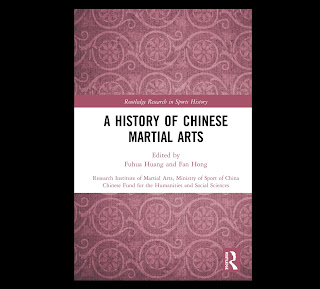
  I'm pleased to share a post from Dr Jonathan Clements. You may remember Dr Clements from the story  Best Book Winner: General Martial Arts Histories in English , for his book A Brief History of the Martial Arts .  Dr Clements joined Martial History Team today by virtue of contributing this thorough and insightful review. Welcome aboard! Today he is sharing his thoughts on the book A History of Chinese Martial Art s, pictured above, published 21 September 2018. Title: A History of Chinese Martial Arts Editors: Huang Fuhua and Hong Fan Publisher: Routledge Format: Hardback, paperback, Kindle Pages: 240, 6 x 9 inches Cover Price: $140, $51, $36.99 ISBN: 978-1138645585 Content Originally published in Chinese in 1997 by the People’s Sports Press, A History of Chinese Martial Arts credits editors Huang Fuhua and Hong Fan on its title page. They are, in fact, the English-language vectors for an entire council of scholars, many of them firmly co-opted with the “sportifie...

Did Miyamoto Musashi Say "There is more than one path to the top of the mountain."?

Image
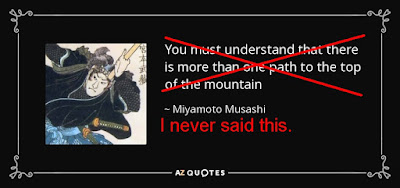
   Did Miyamoto Musashi Say "There is more than one path to the top of the mountain."? Introduction I came across this quote in one of my martial arts Facebook groups. I am completing a survey of books by and about Miyamoto Musashi (1582-1645), and I did not recall reading this phrase. The sentiment also appeared to be completely opposite to what Musashi thought, as he is very direct and precise about how to live. I decided to research this quote. The Source The Martial Artist's Book of Five Rings, 1994 The source of this saying is easy enough to find. It appears in the book first published by Tuttle in 1994 as  The Martial Artist's Book of Five Rings , by Steve Kaufman. The subtitle says "The definitive interpretation of Miyamoto Musashi's classic book of strategy." Since 2004, Tuttle has sold it as  Musashi's Book of Five Rings . I already described why this book has nothing to do with what Miyamoto Musashi actually said. Please see my post  Did Mi...

The Bruce Lee Library and More

Image
  Where can one find reputable Bruce Lee quotes?  Introduction  It's common to find quotes by Bruce Lee throughout social media. A fair number of these quotes are just plain fakes. There's so many false "quotes" on the Internet that I (Richard) occasionally research them for a dedicated affiliated blog called Sourcing Bruce Lee .  If there are so many fakes around, how does one find reputable Bruce Lee quotes? This post will introduce several sets of resources, starting with Tuttle's Bruce Lee Library. These books, especially those in the Library, are the sources social media users will find as the most accurate and fruitful repositories of Bruce Lee material. The Bruce Lee Library: "Tier Zero" Sources Tier Zero Sources: The Bruce Lee Library, volumes 1-8 The Bruce Lee Library is a series of 8 books originally produced by Tuttle Publishing  between 1997 and 2000. They are mainly written by John Little. His LinkedIn page states that he was the literary e...