Posts

Showing posts with the label jiujitsu

August 2022 Book Survey Part 2

Image
   Welcome to the August 2022 book survey, part two. I decided to break this month's survey into two posts, as I did last month. Introduction In August 2022, I (Richard) continued my reading plan. This post describes 7 more books that I surveyed in August. Part 1 addressed the first 8 that I surveyed last month. Read on to separate the wheat from the chaff.  Brazilian Jiu-Jitsu: Theory and Technique, Renzo Gracie, Royler Gracie, Kid Peligro, John Danaher, 2001 Brazilian Jiu-Jitsu: Theory and Technique  begins our look at Brazilian jiu-jitsu books for this month. My copy is an 8 1/2 inch by 11 inch color paperback with heavy glossy paper and 256 pages. This appears to be the first book featuring the philosopher of BJJ, John Danaher. The book offers a section on theory, followed by 110 techniques, each occupying two pages. They are grouped according to rank (blue, purple, brown, black), but that appears to be more for organizational purposes. It's clear to me professo...

Hokusai Martial Arts Manga

Image
Slap - bump - roll! Introduction  Katsushika Hokusai was a Japanese artist who lived during the Edo period. He is presumed to have been born in 1760 and he died in 1849. He is likely the most famous Japanese artist of all time, and you have probably already seen his wonderful painting titled "The Great Wave off Kanagawa." Hokusai also produced sketches of martial arts scenes. The ones with which I am currently familiar appear in several volumes of his "manga" or sketchbook series, published beginning in 1814. All 14 volumes are available online courtesy of the Smithsonian .  I wanted to highlight a few I thought were interesting in this post. Sumo and Grapplers in Volumes 3 and 11 The following picture of Sumo wrestlers appears in Hokusai manga 北斎漫画, Vol. 3, FSC-GR-780.233.1-14 pp 12-13 : Hokusai Manga Vol 3 pp 12-13, http://pulverer.si.edu/node/663/title/3/7 The Sumo wrestlers appear to be much thinner than today's version, and they appear to be engaged in more...

John Danaher on Techniques without Precedence

Image
Are there any techniques in judo or jiu-jitsu that have no precedence, at least prior to the 20th century? Professor John Danaher addressed this subject in two videos from December 2018. I watched them today after YouTube suggested them to me. Apparently Google knows I'm a big fan of Prof Danaher. I've watched several of his videos, I own the book he co-authored with Prof Renzo Gracie, and I even bought both of the Danaher Diaries published by another fan! Ude Hishigi Juji Gatame (腕挫十字固) - The Armbar John Danaher Juji Gatame, https://www.youtube.com/watch?v=GshEzcqlUbY The first video I watched showed Prof Danaher talking about [udi hishige] juji gatame (腕挫十字固), or the armbar from the mount as shown above. In the video , Prof Danaher says: "In the case of juji gatame we don't see any renditions of juji gatame outside of one country, Japan, until the 20th century , when Japan had opened up and began spreading it, their grappling technology, around the world... To th...

On 柔術 Jūjutsu

Image
柔術   jūjutsu How does one translate 柔術 to English? I liked the explanation in Choque Vol 1 by Roberto Pedreira : "[jūjutsu] “Juu-Jutsu (in Japanese), 柔術 can be literally translated in a number of ways. 柔 and 術 are bound morphemes, meaning that they occur only in combinations (when they are pronounced as “juu” and “jutsu” respectively). Separately, 柔 is pronounced “yawa” as in “yawarakaii” (柔らかい) and means “flexible, not firm, not stiff”. 術 means technique, method, skill. Together they are pronounced juu-jutsu (vowel length is phonemic in Japanese; “uu” indicates that the “u” sound is held twice as long.” I also like the paper by Martial History Team member Matthew Krueger:  Jujutsu, Judo and Jiu-jitsu: A Historical Comparison of Terms . Today I read in the Facebook group Vintage Martial Arts Books, Magazines, and Clips Share a fascinating exchange that offered some excellent explanations. A user named ERozmin-Sensei Lakan Dalawa citing another user na...

Hidari Ashi Jime or Rubber Guard?

Image
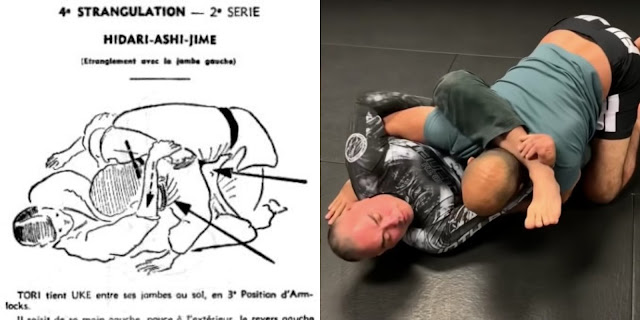
Facebook Post by Heme Baban,  https://www.facebook.com/groups/209635812396449/permalink/3606718996021430/ Introduction I'd like to make a brief point about the history of martial arts technique. The image above appeared in a Facebook post to the Kosen Judo Academy group, which is private. The comment said "Before Eddie or the gracies were born, we had these techniques in JUDO! HIDARI ASHI JIME known as The Rubber Guard within the Jiu Jitsu and MMA community." Is this a fair comment? Mikinosuke Kawaishi I recognized the image on the left as being from the French edition of Ma Methode du Judo by Prof Mikinosuke Kawaishi: Hidari Ashi Jime, Ma Methode du Judo, Mikinosuke Kawaishi, 1960 The image depicts Hidari Ashi Jime, or "left leg strangle," a submission that involves a combination of using the left hand grasping the opponent's gi collar while the right hand holds one's left leg. Yes, this is the same professor as mentioned in a rece...

Annotating Wayne Muromoto's "The Legacy of Chin Gempin"

Image
Muromachi Period Samurai, 1538, Wikipedia Commons,  https://en.wikipedia.org/wiki/Muromachi_period#/media/File:MuromachiSamurai1538.jpg Introduction Quite often we in the martial arts hear the idea that the Japanese learned martial arts from the Chinese. The next step in that conversation is the mention of the Chinese scholar Chin Gempin (1587-1674), aka Chen Gemin / Chen Yuan-pin / Ch'en Yuan-pin / Chen Yuan-Ping / Chen Tsu U / Gin Chin Pin. He's sometimes cited as being responsible for the creation of grappling arts in Japan. In this post, I'd like to set up some context, and then provide an annotated version of a classic article that casts Chin Gempin's true role in Japanese arts, with a focus on grappling. Mentions of Chinese Origins for Japanese Grappling Arts Fundamentals of Shuai Chiao (Jiao) by Dr Daniel Weng, 1984 In Dr Daniel Weng's 1984 book Fundamentals of Shuai Chiao , we find claims like the following: "It has been proven that ...

Answering the Top Five Questions on Theodore Roosevelt's Judo

Image
Richmond-Times Dispatch, 14 Nov 1917 Introduction One of the most popular set of myths found in a variety of media involves the association of President Theodore Roosevelt Jr. (1858-1919, 26th US president) with martial arts, especially judo or jiu-jitsu.  According to the Theodore Roosevelt Center : "Teedie [Theodore Jr.'s childhood nickname] battled frequent asthma attacks . In time, Theodore Sr. challenged his namesake 'to make his body' and overcome his infirmities. Eager to please the father he adored, Teedie committed himself to a regimen of vigorous physical activity , a routine that remained with him well into adulthood. After a confrontation with bullies who pummeled Teedie , Thee [Theodore Sr.] encouraged his son to take up boxing." That sounds a bit like other martial arts practitioners and founders profiled earlier on this blog ! So what are the myths and what are the facts? In the following, TR is an abbreviation referring to T...