Posts

Showing posts with the label history

Did Kano Jigoro Ask to Be Buried in a White Belt?

Image
  Did Kano Jigoro ask to be buried in a white belt? Introduction Today I encountered the following excerpt from a book published in 1992 by an Aikido practitioner named George Leonard, titled Mastery: The Keys to Success and Long-Term Fulfilment : “When Jigoro Kano, the founder of judo, was quite old and close to death, the story goes, he called his students around him and told them he wanted to be buried in his white belt. What a touching story; how humble of the world's highest-ranking judoist in his last days to ask for the emblem of the beginner! But Kano's request, I eventually realized, was less humility than realism. At the moment of death, the ultimate transformation, we are all white belts. And if death makes beginners of us, so does life—again and again. In the master's secret mirror, even at the moment of highest renown and accomplishment, there is an image of the newest student in class, eager for knowledge, willing to play the fool. And for all who walk the pat...

Investigating a Suspicious Book Cover

Image
  Just who are these gentlemen? Introduction This post documents my investigation of the men in the photo above. It is a version of the cover of a 2020 book by Marc Lawrence titled  The Scientific Study of the Shanghai Municipal Police Methods Manual . The cover presumes to show two famous proponents of combatives, namely Captains Fairbairn and Sykes, plus two men who were their instructors -- professors Okada and Tsai. The former specialed in jujutsu and the latter in Chinese boxing. This article offers a few details. The cover as shown at Amazon appears below. The Scientific Study of the Shanghai Municipal Police Methods Manual , Marc Lawrence, 2020 The problem with this photo is that half of the labels are demonstrably false . Fairbairn? First, the gentleman labelled William E. Fairbairn is actually Harold Peck.  The original photo can be found in the Historical Photographs of China collection as "Harold Peck with three men."  We can identify the man as Harold P...

Dr Paul Bowman on Making Martial Arts History Matter (2016)

Image
A few months ago I (Richard) wrote a post titled Why Should Practitioners Care About Martial Arts History?   I spoke about this on Whistlekick Live in December 2020 , thanks to host Jeremy Lesniak.  (Note the Pedro Sauer gi over my work shirt.) Whistlekick Live, 2 December 2020 Thanks to a post in a private Facebook group, I came across a quote from a 2016 article by Dr Paul Bomwan titled  Making Martial Arts History Matter . As I read the entire paper, I realized I had encountered some or all of the material before -- probably in one of Dr Bowman's excellent books. I decided to highlight a few passages here, as they speak to the relevance of martial arts history. I thought Dr Bowman's article was well-cited and made several compelling points. I have added all of the emphasis in bold to Dr Bowman's original material. "Unsurprisingly, in much scholarship on Asian martial arts, the matter of history remains freighted and weighted down by the same popular myths; so much ...

Why Should Practitioners Care About Martial Arts History?

Image
 Why should practitioners care about martial arts history?  Introduction To answer this question, I'd like to divide martial arts practitioners into two approximate, somewhat stereotypical, camps. Division should not be the goal of the martial arts community. However, it is difficult to analyze as broad a group as "all martial artists." My hope is that these terms will facilitate the identification of common characteristics and the formulation of reasonable conclusions. The first group consists of people who seek excellence by replicating or emulating the original teachings of their art. I call these practitioners emulators . The second group includes people who seek excellence by testing their art against other practitioners. I call them contestants . There is overlap among the groups, but this differentiation provides a rough starting point for the discussion. I seek no value judgement concerning either group and I have personally trained in both modes. Emulators Within...

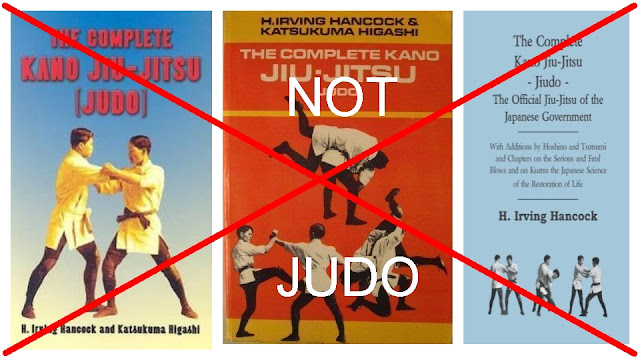
"The Complete Kano Jiu-Jitsu" Is Not Judo

Image
  Introduction  Once in a while I will encounter a reader who has fallen for a 115-year-old scam perpetrated by martial arts authors trying to capitalize on the name of judo founder professor Jigoro Kano. In today's post, I'd like to take a look at this scam, and make it easier for others to know what they are reading. It doesn't mean readers should avoid the book. I'm more interested in "truth in advertising." The (so-called) Complete Kano Jiu-Jitsu (Judo) That scam is the 1905 book  The Complete Kano Jiu-Jitsu (Judo) by H. Irving Hancock and Katsukuma Higashi, published by G. P. Putnam's Sons. Interior of The Complete Kano Jiu-Jitsu (Judo) by H. Irving Hancock and Katsukuma Higashi, G. P. Putnam's Sons, 1905. The foreword to the book says the following: The Complete Kano Jiu-Jitsu (Judo) by H. Irving Hancock and Katsukuma Higashi, G. P. Putnam's Sons, 1905. It reads in part "This volume, therefore, presents, in its entirety, the Kano system...

Notes on Dr Lorge Interview

Image
  Dr Paul Bowman interviewed Dr Peter Lorge again on his excellent series on martial arts studies. I took the following notes and decided to publish them, in case anyone also finds them interesting. Not everything in China is at least 2000 (or 5000 years old).  China is not "unchanging and forever." Not everything good about Japan, Korea, or Vietnam came from China. French wine in a foreign country doesn't become domesticated, but physical practice does. "Confucianism" was an attempt by European scholars and missionaries to create a secular intellectual tradition in opposition to Taoism and Buddhism. They viewed what they called "Confucianism" as being like Christianity, except without Jesus, and it became their means to try to convert Chinese people to Christianity. Buddhism entered China around the first century CE. Dr Lorge prefers the term " Ruist " to "Confucian." "Confucianism" has changed over time based on who ass...

Comparing Translations of Itosu’s Ten Precepts of Karate

Image
  What did Ankō Itosu really say in his first precept of Karate?  Introduction I finished reading Sensei Patrick McCarthy's latest edition of the Okinawan  Bubishi , a martial arts manuscript that will be the subject of future book reviews. In the book, Sensei McCarthy included his translation of a related document by Sensei Ankō Itosu (1831-1915), a karate master who is beginning to receive more attention for his role in creating modern karate.  In 1908 Sensei Itosu wrote a letter titled Ten Precepts of Karate, intended to be read by Japan's Ministry of Education and Ministry of War. Itosu wanted to promote karate within Japan and explained its benefits. It was McCarthy's translation of the first precept that prompted this post. McCarthy's Translation of the First Precept McCarthy's Translation of the First Precept, Bubishi, 2016 The underlined text from page 254 of the 2016 edition of McCarthy's Bubishi made me stop and think. McCarthy translated Itosu as sayi...