Posts

Showing posts with the label jujutsu

June 2023 Book Survey Part 1

Image
   Welcome to the June 2023 book survey, part one. I decided to break this month's survey into four posts. The themes for this month are diverse, but include Japanese arts, Filipino arts, and European arts. These are generally the last print books in my library that have not been previously surveyed. Introduction In June 2023, I (Richard) continued my book survey plan. This post examines several books on Japanese arts. The Ninja and Their Secret Fighting Art, Stephen K. Hayes, 1981 I have both digital and physical copies of  The Ninja and Their Secret Fighting Art , originally published in 1981. Tuttle appears to repackage it every few years with a new cover. I included the covers of the two versions in my library. My softcover print copy measures 5 1/4 inches by 8 inches with 156 black and white pages. This was not Mr. Hayes' first book on ninja. His first appears to be a pamphlet published in 1975. He also wrote a six volume set beginning in 1980, but this book does not...

August 2022 Book Survey Part 2

Image
   Welcome to the August 2022 book survey, part two. I decided to break this month's survey into two posts, as I did last month. Introduction In August 2022, I (Richard) continued my reading plan. This post describes 7 more books that I surveyed in August. Part 1 addressed the first 8 that I surveyed last month. Read on to separate the wheat from the chaff.  Brazilian Jiu-Jitsu: Theory and Technique, Renzo Gracie, Royler Gracie, Kid Peligro, John Danaher, 2001 Brazilian Jiu-Jitsu: Theory and Technique  begins our look at Brazilian jiu-jitsu books for this month. My copy is an 8 1/2 inch by 11 inch color paperback with heavy glossy paper and 256 pages. This appears to be the first book featuring the philosopher of BJJ, John Danaher. The book offers a section on theory, followed by 110 techniques, each occupying two pages. They are grouped according to rank (blue, purple, brown, black), but that appears to be more for organizational purposes. It's clear to me professo...

Beware Your Sources: A Brief Look at Kano Jigoro's Paper on Jiujutsu and Jiudo-Judo

Image
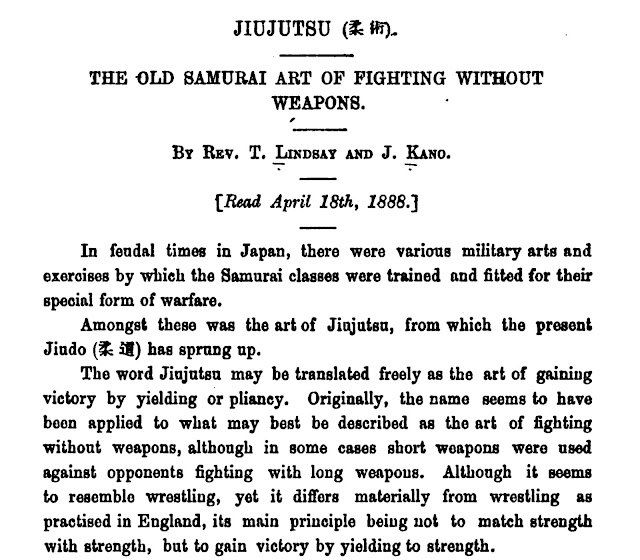
  Introduction While working on the monthly Martial History Team book survey, I needed to research the famous late 19th century paper on "jiujutsu" by professor Kano Jigoro and the Reverend Thomas Lindsay. A quick Google search yielded the version hosted by Judoinfo titled "Jujutsu and the origins of Judo, by Jigoro Kano and T. Lindsay, 1887, (Transactions of the Asiatic Society of Japan, Volume 15)." In addition to seeing the word "judo" in the title, I saw it throughout the online text, e.g., "Amongst these was the art of jujutsu, from which the present judo has sprung up." This did not seem right to me, so I investigated further. Going to the Source Thanks to the wonderful Internet Archive , I was able to find a copy of the original article in its original form. It appeared in Volume XVI (16), not volume "15", of the Transactions of the Asiatic Society of Japan, published in 1889, not 1887. The paper notes that the authors read it t...

Hokusai Martial Arts Manga

Image
Slap - bump - roll! Introduction  Katsushika Hokusai was a Japanese artist who lived during the Edo period. He is presumed to have been born in 1760 and he died in 1849. He is likely the most famous Japanese artist of all time, and you have probably already seen his wonderful painting titled "The Great Wave off Kanagawa." Hokusai also produced sketches of martial arts scenes. The ones with which I am currently familiar appear in several volumes of his "manga" or sketchbook series, published beginning in 1814. All 14 volumes are available online courtesy of the Smithsonian .  I wanted to highlight a few I thought were interesting in this post. Sumo and Grapplers in Volumes 3 and 11 The following picture of Sumo wrestlers appears in Hokusai manga 北斎漫画, Vol. 3, FSC-GR-780.233.1-14 pp 12-13 : Hokusai Manga Vol 3 pp 12-13, http://pulverer.si.edu/node/663/title/3/7 The Sumo wrestlers appear to be much thinner than today's version, and they appear to be engaged in more...

On 柔術 Jūjutsu

Image
柔術   jūjutsu How does one translate 柔術 to English? I liked the explanation in Choque Vol 1 by Roberto Pedreira : "[jūjutsu] “Juu-Jutsu (in Japanese), 柔術 can be literally translated in a number of ways. 柔 and 術 are bound morphemes, meaning that they occur only in combinations (when they are pronounced as “juu” and “jutsu” respectively). Separately, 柔 is pronounced “yawa” as in “yawarakaii” (柔らかい) and means “flexible, not firm, not stiff”. 術 means technique, method, skill. Together they are pronounced juu-jutsu (vowel length is phonemic in Japanese; “uu” indicates that the “u” sound is held twice as long.” I also like the paper by Martial History Team member Matthew Krueger:  Jujutsu, Judo and Jiu-jitsu: A Historical Comparison of Terms . Today I read in the Facebook group Vintage Martial Arts Books, Magazines, and Clips Share a fascinating exchange that offered some excellent explanations. A user named ERozmin-Sensei Lakan Dalawa citing another user na...

Annotating Wayne Muromoto's "The Legacy of Chin Gempin"

Image
Muromachi Period Samurai, 1538, Wikipedia Commons,  https://en.wikipedia.org/wiki/Muromachi_period#/media/File:MuromachiSamurai1538.jpg Introduction Quite often we in the martial arts hear the idea that the Japanese learned martial arts from the Chinese. The next step in that conversation is the mention of the Chinese scholar Chin Gempin (1587-1674), aka Chen Gemin / Chen Yuan-pin / Ch'en Yuan-pin / Chen Yuan-Ping / Chen Tsu U / Gin Chin Pin. He's sometimes cited as being responsible for the creation of grappling arts in Japan. In this post, I'd like to set up some context, and then provide an annotated version of a classic article that casts Chin Gempin's true role in Japanese arts, with a focus on grappling. Mentions of Chinese Origins for Japanese Grappling Arts Fundamentals of Shuai Chiao (Jiao) by Dr Daniel Weng, 1984 In Dr Daniel Weng's 1984 book Fundamentals of Shuai Chiao , we find claims like the following: "It has been proven that ...

Is Firearm Use a Martial Art?

Image
Morishige Ryu Hojutsu - 41st All Japan Kobudo Demonstration (2018), YouTube, https://www.youtube.com/watch?v=raFwIlok9_Y Introduction Periodically on martial arts forums I will encounter debates on whether or not firearm use is, or can be, a martial art. The resistance to firearm use being a martial art usually appears in the more traditional communities. Being "traditional," they see firearms as a modern invention that, logically speaking from this point of view, are not appropriate for armed or unarmed martial arts. Does this make sense, from an historical point of view? Enter Hojutsu Yo Ryu Hojutsu  - Onoue Kiyoe - 42nd All Japan Kobudo Demonstration, YouTube,  https://www.youtube.com/watch?v=rX9EiuFepz8 Today I was watching videos from Japan recorded in 2019 at the 42nd All Japan Kobudo Demonstration. This appears to be an annual event, as I also watched a few from the 43rd event in February 2020. Kobudo means ancient or old martial way, an...