Posts

Hokusai Martial Arts Manga

Image
Slap - bump - roll! Introduction  Katsushika Hokusai was a Japanese artist who lived during the Edo period. He is presumed to have been born in 1760 and he died in 1849. He is likely the most famous Japanese artist of all time, and you have probably already seen his wonderful painting titled "The Great Wave off Kanagawa." Hokusai also produced sketches of martial arts scenes. The ones with which I am currently familiar appear in several volumes of his "manga" or sketchbook series, published beginning in 1814. All 14 volumes are available online courtesy of the Smithsonian .  I wanted to highlight a few I thought were interesting in this post. Sumo and Grapplers in Volumes 3 and 11 The following picture of Sumo wrestlers appears in Hokusai manga 北斎漫画, Vol. 3, FSC-GR-780.233.1-14 pp 12-13 : Hokusai Manga Vol 3 pp 12-13, http://pulverer.si.edu/node/663/title/3/7 The Sumo wrestlers appear to be much thinner than today's version, and they appear to be engaged in more...

Reading Plan 2H2020 to 2H2021

Image
How do I (Richard) plan to spend my reading time for the rest of 2020 and the first half of 2021? Overview  My personal martial arts library consists of several collections: print books, digital books, digital papers and articles, and digital media (instructionals, videos, and the like). One of my goals for Martial History Team is to review this material and produce recommended reading (or watching) lists, at least for the topics for which I have coverage and which personally interest me. In doing so I hope to encourage others, whether part of MHT or not, to do the same, thereby making it easier for martial arts researchers and enthusiasts to recognize quality sources and avoid less reliable material. Thus far I have been reading in an ad-hoc manner, depending on whatever interests I might have at the moment. This weekend I decided to formalize my reading plan such that I could cover certain materials and topics within a defined period of time. Focus Areas My current focus is on pr...

I Swear It Upon Zeus, Socrates Did Not Favor Wrestlers over Runners

Image
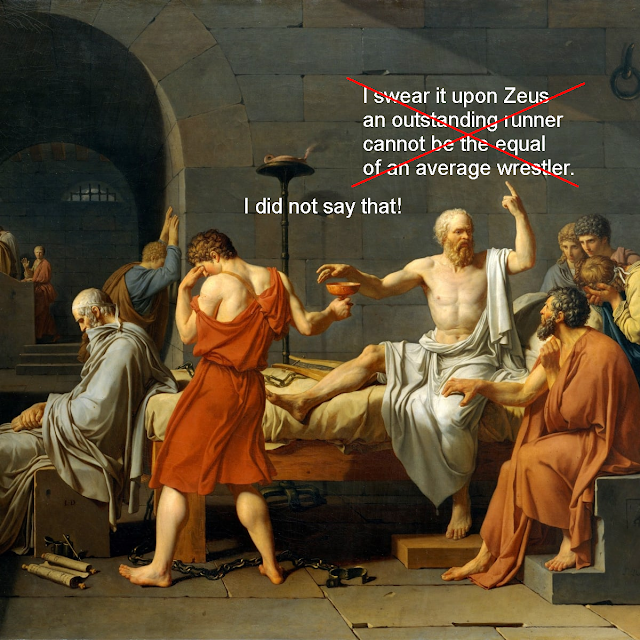
Did Socrates really say "I swear it upon Zeus, an outstanding runner cannot be the equal of an average wrestler"? TL;DR: The image says it all. For the research, and what Socrates and others really said about wrestlers and runners, read on! Introduction Recently I debunked a quote falsely attributed to a Japanese thinker and warrior , so I thought it was time to do the same for a Greek thinker and warrior -- Socrates. First, some background. Socrates was a Greek philosopher who lived from approximately 470 BC to 399 BC. He did not write anything on his own, or at least nothing he wrote survives to this day. Everything we know about him comes from his students and biographers. Chief among these are students Plato and Xenophon, and biographers Plutarch (46 AD to about 119 AD) and Diogenes Laërtius (third century AD) and Plutarch.  To see if Socrates said anything like the quote attributed above, I queried many sources online, and then I reviewed the following works. Each initia...

John Danaher on Techniques without Precedence

Image
Are there any techniques in judo or jiu-jitsu that have no precedence, at least prior to the 20th century? Professor John Danaher addressed this subject in two videos from December 2018. I watched them today after YouTube suggested them to me. Apparently Google knows I'm a big fan of Prof Danaher. I've watched several of his videos, I own the book he co-authored with Prof Renzo Gracie, and I even bought both of the Danaher Diaries published by another fan! Ude Hishigi Juji Gatame (腕挫十字固) - The Armbar John Danaher Juji Gatame, https://www.youtube.com/watch?v=GshEzcqlUbY The first video I watched showed Prof Danaher talking about [udi hishige] juji gatame (腕挫十字固), or the armbar from the mount as shown above. In the video , Prof Danaher says: "In the case of juji gatame we don't see any renditions of juji gatame outside of one country, Japan, until the 20th century , when Japan had opened up and began spreading it, their grappling technology, around the world... To th...

On 柔術 Jūjutsu

Image
柔術   jūjutsu How does one translate 柔術 to English? I liked the explanation in Choque Vol 1 by Roberto Pedreira : "[jūjutsu] “Juu-Jutsu (in Japanese), 柔術 can be literally translated in a number of ways. 柔 and 術 are bound morphemes, meaning that they occur only in combinations (when they are pronounced as “juu” and “jutsu” respectively). Separately, 柔 is pronounced “yawa” as in “yawarakaii” (柔らかい) and means “flexible, not firm, not stiff”. 術 means technique, method, skill. Together they are pronounced juu-jutsu (vowel length is phonemic in Japanese; “uu” indicates that the “u” sound is held twice as long.” I also like the paper by Martial History Team member Matthew Krueger:  Jujutsu, Judo and Jiu-jitsu: A Historical Comparison of Terms . Today I read in the Facebook group Vintage Martial Arts Books, Magazines, and Clips Share a fascinating exchange that offered some excellent explanations. A user named ERozmin-Sensei Lakan Dalawa citing another user na...

Did Miyamoto Musashi Say Something Like "There is nothing outside of yourself..."?

Image
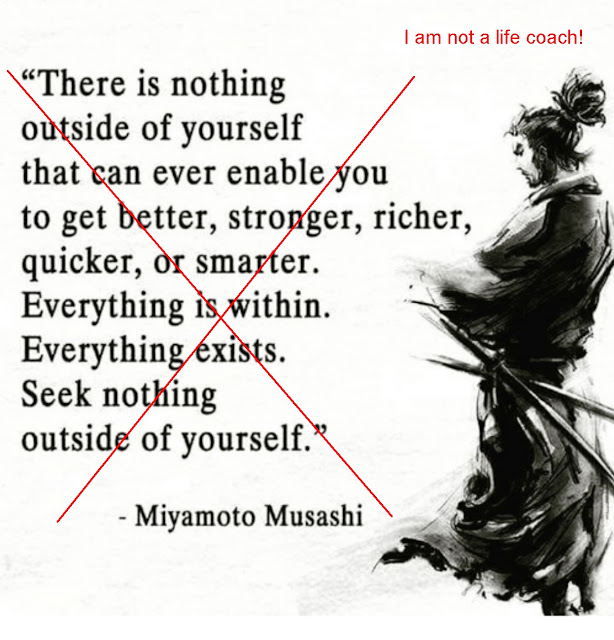
I am not a life coach! Introduction Aside from sourcing so-called "Bruce Lee quotes,"  I usually don't pay much attention to other sayings attributed to martial artists. I ran into this quote yesterday, however, and it triggered my radar: "There is nothing outside of yourself that can ever enable you to get better, stronger, richer, quicker, or smarter. Everything is within. Everything exists. Seek nothing outside of yourself." The quote is attributed to Miyamoto Musashi, the famous Japanese swordsman who was the topic of the first official Martial History Team podcast episode . The question is, did he say anything like this? The Source The Martial Artist's Book of Five Rings, 1994 The source of this saying is easy enough to find. It appears in the book first published by Tuttle in 1994 as The Martial Artist's Book of Five Rings , by Steve Kaufman. The subtitle says "The definitive interpretation of Miyamoto Musashi's clas...

Hidari Ashi Jime or Rubber Guard?

Image
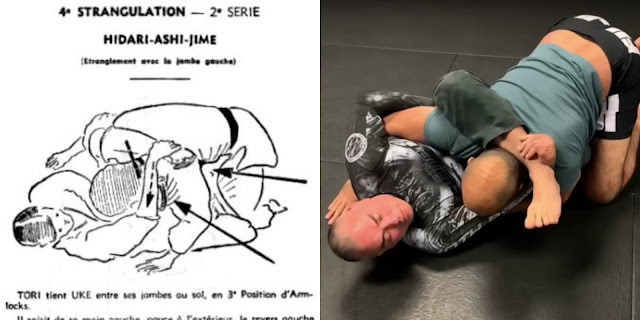
Facebook Post by Heme Baban,  https://www.facebook.com/groups/209635812396449/permalink/3606718996021430/ Introduction I'd like to make a brief point about the history of martial arts technique. The image above appeared in a Facebook post to the Kosen Judo Academy group, which is private. The comment said "Before Eddie or the gracies were born, we had these techniques in JUDO! HIDARI ASHI JIME known as The Rubber Guard within the Jiu Jitsu and MMA community." Is this a fair comment? Mikinosuke Kawaishi I recognized the image on the left as being from the French edition of Ma Methode du Judo by Prof Mikinosuke Kawaishi: Hidari Ashi Jime, Ma Methode du Judo, Mikinosuke Kawaishi, 1960 The image depicts Hidari Ashi Jime, or "left leg strangle," a submission that involves a combination of using the left hand grasping the opponent's gi collar while the right hand holds one's left leg. Yes, this is the same professor as mentioned in a rece...