Posts

The Bruce Lee Library and More

Image
  Where can one find reputable Bruce Lee quotes?  Introduction  It's common to find quotes by Bruce Lee throughout social media. A fair number of these quotes are just plain fakes. There's so many false "quotes" on the Internet that I (Richard) occasionally research them for a dedicated affiliated blog called Sourcing Bruce Lee .  If there are so many fakes around, how does one find reputable Bruce Lee quotes? This post will introduce several sets of resources, starting with Tuttle's Bruce Lee Library. These books, especially those in the Library, are the sources social media users will find as the most accurate and fruitful repositories of Bruce Lee material. The Bruce Lee Library: "Tier Zero" Sources Tier Zero Sources: The Bruce Lee Library, volumes 1-8 The Bruce Lee Library is a series of 8 books originally produced by Tuttle Publishing  between 1997 and 2000. They are mainly written by John Little. His LinkedIn page states that he was the literary e...

Best Book Winner: General Martial Arts Histories in English

Image
  What English language general martial art history book does Martial History Team recommend?  Introduction When I (Richard) started Martial History Team in late January 2020, I said that the goal of the project was to promote martial arts history based on sound evidence and sourced research. In late June I published Best Book Winner: Professor Kano Biographies in English , my first attempt at guiding interested readers toward specific resources on a single topic. Today I'm pleased to provide a second specific recommendation, based on reading several books, some of which were quite lengthy. That delayed production, along with my focus on publishing several book relating to cybersecurity, explained in my post Quick Update on Martial History Team Status . With that groundwork laid, on to the list! The List The following are the 6 titles in consideration. The title links to an Amazon page, if available, or to the publisher. The rating links to my reviews at Martial Journal , when...

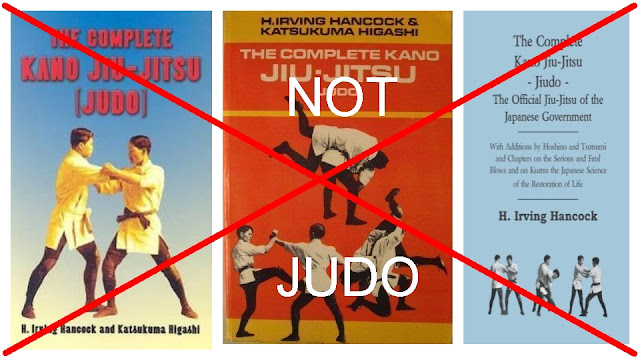
"The Complete Kano Jiu-Jitsu" Is Not Judo

Image
  Introduction  Once in a while I will encounter a reader who has fallen for a 115-year-old scam perpetrated by martial arts authors trying to capitalize on the name of judo founder professor Jigoro Kano. In today's post, I'd like to take a look at this scam, and make it easier for others to know what they are reading. It doesn't mean readers should avoid the book. I'm more interested in "truth in advertising." The (so-called) Complete Kano Jiu-Jitsu (Judo) That scam is the 1905 book  The Complete Kano Jiu-Jitsu (Judo) by H. Irving Hancock and Katsukuma Higashi, published by G. P. Putnam's Sons. Interior of The Complete Kano Jiu-Jitsu (Judo) by H. Irving Hancock and Katsukuma Higashi, G. P. Putnam's Sons, 1905. The foreword to the book says the following: The Complete Kano Jiu-Jitsu (Judo) by H. Irving Hancock and Katsukuma Higashi, G. P. Putnam's Sons, 1905. It reads in part "This volume, therefore, presents, in its entirety, the Kano system...

Notes on Dr Lorge Interview

Image
  Dr Paul Bowman interviewed Dr Peter Lorge again on his excellent series on martial arts studies. I took the following notes and decided to publish them, in case anyone also finds them interesting. Not everything in China is at least 2000 (or 5000 years old).  China is not "unchanging and forever." Not everything good about Japan, Korea, or Vietnam came from China. French wine in a foreign country doesn't become domesticated, but physical practice does. "Confucianism" was an attempt by European scholars and missionaries to create a secular intellectual tradition in opposition to Taoism and Buddhism. They viewed what they called "Confucianism" as being like Christianity, except without Jesus, and it became their means to try to convert Chinese people to Christianity. Buddhism entered China around the first century CE. Dr Lorge prefers the term " Ruist " to "Confucian." "Confucianism" has changed over time based on who ass...

Quick Update on Martial History Team Status

Image
  This is Richard Bejtlich writing today.  I wanted to offer a quick update on the status of Martial History Team .  It's been about two months since the last post to the blog . I haven't had the focus to work on any dedicated, longer-form research for the team during the last few months. The primary reason is that in my spare time I've been working on the second volume of my latest cyber security project , shown in the image. I plan to finish that book this month, and then turn my attention to volume 3. Working on that book is a project outside of my day job, which also involves cyber security. While writing these books, I'm still reading martial arts history and research. I'm also producing regular social media content on the Martial History Team Twitter , Instagram , and Facebook pages. Thanks to Matthew Krueger, we also have a few new Martial History Team podcast episodes! Finally, in fits and spurts, I write book reviews for Martial Journal . I've also be...

Best Book Winner: Professor Kano Biographies in English

Image
What English language biography of professor Jigoro Kano does Martial History Team recommend?  Introduction  When I (Richard) started Martial History Team in late January 2020, I said that the goal of the project was to promote martial arts history based on sound evidence and sourced research. Since then, readers have been able to consume a lot of content from the project, through a  Facebook page , this blog , Instagram , Twitter , and, thanks to team member Matthew Krueger , via a podcast . Along the way I published a post on the criteria I use when evaluating sources . That guided my selections. Today, I'm happy to present the first reading recommendation. Here I will list the 8 biographies of professor Jigoro Kano that I read, and share the title which I believe is the best English-language biography available to the average reader. The List The following are the 8 titles in consideration. The title links to an Amazon page, if available, or to the publisher. The ...

Comparing Translations of Itosu’s Ten Precepts of Karate

Image
  What did Ankō Itosu really say in his first precept of Karate?  Introduction I finished reading Sensei Patrick McCarthy's latest edition of the Okinawan  Bubishi , a martial arts manuscript that will be the subject of future book reviews. In the book, Sensei McCarthy included his translation of a related document by Sensei Ankō Itosu (1831-1915), a karate master who is beginning to receive more attention for his role in creating modern karate.  In 1908 Sensei Itosu wrote a letter titled Ten Precepts of Karate, intended to be read by Japan's Ministry of Education and Ministry of War. Itosu wanted to promote karate within Japan and explained its benefits. It was McCarthy's translation of the first precept that prompted this post. McCarthy's Translation of the First Precept McCarthy's Translation of the First Precept, Bubishi, 2016 The underlined text from page 254 of the 2016 edition of McCarthy's Bubishi made me stop and think. McCarthy translated Itosu as sayi...