Posts

March 2021 Book Survey: Stephen Turnbull Samurai Texts

Image
  My reading theme for March 2021 included books by Dr. Stephen Turnbull about Samurai and closely related topics in Japanese history. These are a few thoughts on the titles that I (Richard) read.  Introduction Dr. Turnbull is the most prolific author I have encountered while researching reputable martial arts books. He earned his PhD from Leeds University in 1996, with his thesis addressing Japan's Kakure Kirishitan , or "hidden Christian" communities. I first encountered his work in the form of his excellent 2018 book  Ninja: Unmasking the Myth , which I reviewed for Martial Journal .  This post will include two main sections. The first part offers a deeper look at 4 of Dr. Turnbull's books. They are pictured at the top of the post. The second part lists 27 books that I briefly reviewed. I will make a comment on each.  I previewed these titles in a series of social media posts using the hash tag #StephenTurnbull. Each features art samples from the books. You ...
February 2021 Book Survey: Japanese History Texts

Image
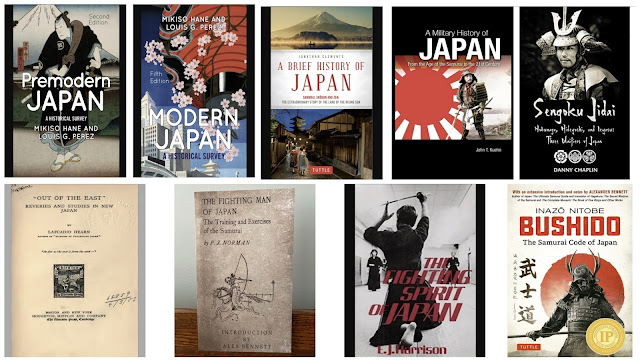
My reading theme for February 2021 was Japanese history texts. These are a few thoughts on the titles I (Richard) read. There are many others, but these are the group I chose to read in February 2021. Introduction Each month I have a theme for my martial arts reading. In January 2021 the theme was Primary Japanese Samurai Philosophy Texts . This month I decided to get a better understanding of Japanese history. I selected a mix of general history texts, military history texts, and first-person accounts. Premodern Japan 2nd Edition and Modern Japan 5th Edition by Mikiso Hane and Louis G. Perez, 2014 and 2012 Premodern Japan 2nd Ed , Mikiso Hane and Louis G. Perez, 2014 Modern Japan 5th Ed , Mikiso Hane and Louis G. Perez, 2012 I present Premodern Japan and Modern Japan together as you could consider them volumes 1 and 2 of a general history of Japan. The authors each earned PhDs. While I could not determine the field for the late Dr. Hane (who passed away in 2003), I read tha...

Beware Your Sources: A Brief Look at Kano Jigoro's Paper on Jiujutsu and Jiudo-Judo

Image
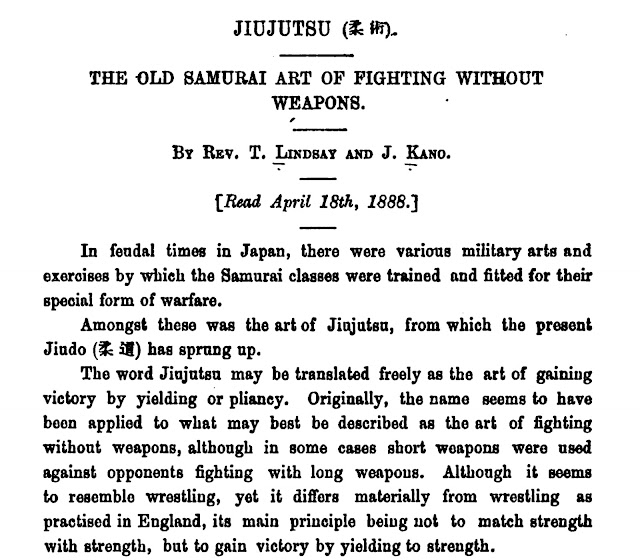
  Introduction While working on the monthly Martial History Team book survey, I needed to research the famous late 19th century paper on "jiujutsu" by professor Kano Jigoro and the Reverend Thomas Lindsay. A quick Google search yielded the version hosted by Judoinfo titled "Jujutsu and the origins of Judo, by Jigoro Kano and T. Lindsay, 1887, (Transactions of the Asiatic Society of Japan, Volume 15)." In addition to seeing the word "judo" in the title, I saw it throughout the online text, e.g., "Amongst these was the art of jujutsu, from which the present judo has sprung up." This did not seem right to me, so I investigated further. Going to the Source Thanks to the wonderful Internet Archive , I was able to find a copy of the original article in its original form. It appeared in Volume XVI (16), not volume "15", of the Transactions of the Asiatic Society of Japan, published in 1889, not 1887. The paper notes that the authors read it t...

Did Kano Jigoro Ask to Be Buried in a White Belt?

Image
  Did Kano Jigoro ask to be buried in a white belt? Introduction Today I encountered the following excerpt from a book published in 1992 by an Aikido practitioner named George Leonard, titled Mastery: The Keys to Success and Long-Term Fulfilment : “When Jigoro Kano, the founder of judo, was quite old and close to death, the story goes, he called his students around him and told them he wanted to be buried in his white belt. What a touching story; how humble of the world's highest-ranking judoist in his last days to ask for the emblem of the beginner! But Kano's request, I eventually realized, was less humility than realism. At the moment of death, the ultimate transformation, we are all white belts. And if death makes beginners of us, so does life—again and again. In the master's secret mirror, even at the moment of highest renown and accomplishment, there is an image of the newest student in class, eager for knowledge, willing to play the fool. And for all who walk the pat...

Does the Budōshoshinshu Use the Term Jūdō?

Image
Does the Budōshoshinshu use the term jūdō? Martial History Team member Matthew Krueger investigates. Introduction Richard Bejtlich recently posted a survey of samurai philosophy texts .    In it he quoted from a section of the Budōshoshinshu  as follows:    “Beyond these, there are the many arts of archery, iaido [drawing the sword and cutting in one movement] and judo; and it is important that young warriors exert themselves day and night to learn these arts well."   He then asked the question:    “Note that I am not convinced the original text uses the term jūdō. It would be worth revisiting the original text to see the Japanese.”   This is an important observation. I also highly doubt it.  The Modern Japanese This is one of the few texts I do not have in the original archaic Japanese, but I do have a modern Japanese translation.    A modern Japanese rendition of that sentence is as follows:   其の他、弓、鉄砲、居合、柔等という萬の武藝と共に、若い...

January 2021 Book Survey: Primary Japanese Samurai Philosophy Texts

Image
My reading theme for January, 2021 was primary Japanese samurai and Zen texts. These are a few thoughts on the titles I read. There are many others, but these are the group I chose to start 2021. Introduction Each month I have a theme for my martial arts reading. In December 2020, my theme was books by and about Miyamoto Musashi , including his Book of Five Rings . This month I decided to look at other books that are primary sources involving Japanese samurai and their philosophy. I added a couple Zen texts as well. For this list, I drew upon citations in several books, such as Alexander Bennett's 2020 book Bushido Explained . Matthew Krueger's Walking with the Tengu podcast  is one of the best sources for understanding what many of these texts mean. Here I want to list the books I read and a few thoughts. For the first four books, I will present them in the estimated order of publication. The Unfettered Mind by Takuan Sōhō (c. 1632) The Unfettered Mind  , Takuan Sōh...